Medical Students
Are you currently enrolled in the University of Minnesota Medical School? Take advantage of the resources we offer to medical students, helping you make the most of your studies on campus and off.
Participate in Your Student Organization
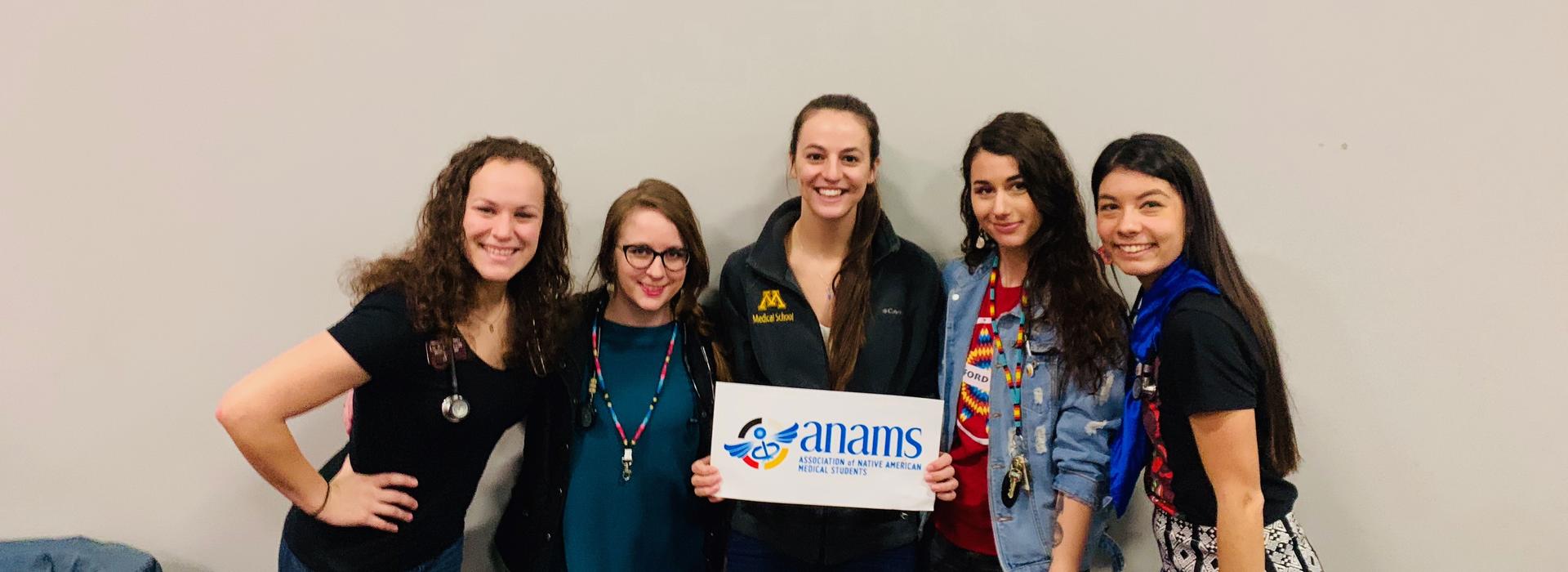
Founded in 1975, the Association of Native American Medical Students (ANAMS) is a student organization representing Native American graduate health profession students throughout the U.S. and Canada. ANAMS offers events, scholarships, a mentoring program, and many other opportunities.
Ongoing Student Support
The Center of American Indian and Minority Health facilitates a variety of events where medical students can network and learn from each other. Specifically, we offer:
- Community and cultural integration events for incoming students
- Monthly breakfast and lunch gatherings
- ANAMS/community lunches
- Participation in community events (pow-wows, health fairs, etc.)
Current AIAN University of Minnesota Medical Students may apply to attend Cross Cultural Medicine Workshop and the Association of American Indian Physicians Conference
Indigenous Health Professions Alliance (IHPA)
In early 2023 University of Minnesota Health Science Leaders from the Schools of Medicine, Nursing, Pharmacy, Veterinary, Dentistry, Public Health, and Medical Research convened around three shared goals: 1.) Increase numbers of American Indian / Alaskan Native (AI/AN) health professionals in the Upper Midwest by 2035 and 2.) Increase knowledge of AI/AN populations. 3.) Unite AI/AN students in all health professions to form a larger community of support for one another.
Our schools collaborate to create a culturally grounded AI/AN student support network that serves scholars across all health sciences. Because relationships and connectedness are common values in AI/AN communities and help build sustainability, we are holding gatherings where students, faculty, and staff from across the health sciences come together and share their experiences in their respective health science programs and professions. Additionally, the Center of American Indian and Minority Health now welcomes Doctoral Graduates from Pharmacy, Nursing, Veterinary, Dentistry, and Public Health to our annual Graduation Honoring.
Hear from Our Current Students!
An Interview with Maria Teachout

Maria's Health Profile
Can you introduce yourself, share where you're from, your pronouns, and what you're currently studying or working on in your health career?
My name is Maria Teachout. My pronouns are she/her/hers. I'm an MS3 at the University of Minnesota Medical School, but currently taking a year off for a Clinical Research Fellowship in Dermatology. I'm an enrolled member of the Sicangu Lakota Oyate (Burnt Thigh Nation), federally called the Rosebud Sioux Tribe.
Why do you think it's important to have more Indigenous representation in health or cancer research, and what motivated you to pursue this path?
It is extremely important to have more Indigenous representation in health and cancer research careers because many healthcare providers lack an understanding of Native communities, their struggles, and how their healthcare systems operate. Having providers who understand these backgrounds fosters a sense of trust and connection, which is vital for effective care. Without this knowledge, patients may face culturally insensitive or uninformed care, which can be detrimental to their health outcomes. It’s also important to have more Indigenous representation in cancer research specifically because Indigenous peoples face a disproportionately high burden of cancer. Having Indigenous representation allows for more culturally appropriate research methods and care as well as increased data accuracy and overall trust within Indigenous communities.
My journey into healthcare was unexpected. I initially studied math with the intention of being an actuary or a teacher as I had some teaching experience. One day, a childhood friend of mine was telling me about her day working as a CNA and I thought it sounded interesting, so I decided to give it a try. Becoming a CNA sparked my interest in medicine. While I could only do so much in that role, I wanted to learn more and have a greater impact. Against all odds, I ended up applying and becoming accepted into medical school which was truly an honor and something I am grateful for.
What has your journey been like so far as an Indigenous person in your academic or professional career? What challenges have you faced, and how have you overcome them?
My journey has been difficult and filled with many challenges. With limited resources growing up on the reservation, I didn’t feel adequately prepared for life after high school. In high school, no one discussed college or career options and there weren’t many opportunities to explore various careers either.
This lack of guidance continued when I pursued medicine—I didn’t know how to apply or what was required. I had to figure things out day by day. Persistence helped me push through, applying with the mindset that I'd either be accepted or move on to plan B. Persistence has been the single most important value that has kept me going through hard times and has allowed me to get where I am today.
How has your community, whether it's your tribe, family, or school, played a role in supporting your academic and professional journey?
The most helpful resources for me as a Native person have been the support from other Native students and the strong Native community in Duluth. Dr. Mary Owen is an amazing person—she's always there to help, even if it's just to provide emotional support. Attending conferences like AAIP, programs like We Are Healers or organizations like ANAMS have also been crucial for building connections. These networks have helped me navigate challenges that I have faced as an Indigenous person, some of which have been dehumanizing. Having others who understand these struggles has been essential for my well-being.
What advice would you give to other Native students who are interested in pursuing health professions, and how do you incorporate your culture and identity into your work?
My advice to other Native students is to remember it’s hard, but you’re not alone. Reach out to other Native students for support—they understand your struggles and have likely faced similar challenges. Building that community can help you push through when things get tough. Many, if not all, of us have struggled, and it’s easy to feel like quitting, but knowing others are going through the same thing can make all the difference. If anyone needs advice or just someone to talk to, I’m always available to help.
I strive to bring Indigeneity into my work and everyday life by remembering the Lakota virtues that we were all taught as children. In healthcare, most of us would agree that having compassion and respect is an essential part of being a good provider, but one virtue that often gets overlooked is humility. I make an effort to incorporate humility into every interaction I have, whether it is with a patient or a coworker. Remembering our traditional virtues and smudging everyday helps to keep me grounded and be the provider that our people need.
An Interview with Katlin Wilson

Katie's Health Profile
Can you introduce yourself, share where you're from, your pronouns, and what you're currently studying or working on in your health career?
míiyu míiyu, notúung Katie yaqáa (“Hi, My name is Katie" in Luiseño). I'm a descendant of the Rincon Band of Luiseno Indians (Southern California). I use she/her pronouns. I am a third-year medical student at the University of Minnesota. I want to be a dermatologist, specifically a dermatopathologist, and continue engaging in AI/AN health equity and advocacy.
Why do you think it's important to have more Indigenous representation in health and cancer research, and what motivated you to pursue this path?
Indigenous representation in health and cancer research is vital due to the mistrust from historical injustices and the significant health disparities Indigenous communities face, including higher rates of chronic diseases and cancer. Indigenous identity is often misunderstood, especially given the political and legal complexities of Tribal Nations and government to government relationships. Without Indigenous voices, researchers may perpetuate colonial harm and overlook cultural values and community needs. Representation ensures healthcare and research are culturally responsive, encouraging trust and positive change not only for Native Americans but for Indigenous peoples globally.
When I was six, I had emergency surgery for a hip infection, followed by months of IV antibiotics. My immune system stopped working and started attacking itself. My hair fell out, followed by years of chronic autoimmune conditions, infections, and constant frustration. No one could say what was wrong with me. Dismissal from physicians on my conditions and identity worsened my agony, especially as a young girl with complete baldness that was told she doesn’t look Native. Growing up I always struggled with my alopecia, and sometimes do to this day. It’s hard when people stare at you for looking different. It showed me how much dermatology can make an impact on people’s health, interconnecting physical, mental and emotional wellbeing. How we present ourselves to the world can have such a huge impact on our daily lives and wellbeing, I just want everyone to be comfortable and confident in their own skin.
As I grew older I saw how medicine treated my family, whether it was the chronic diseases that could have likely been prevented, or how we look or speak influences our treatment. It’s so important to see the person in front of you, seeing their past and present, having appreciation for the beauty in everyone and hearing their story. .
I’m studying medicine with a focus on Indigenous health and dermatology to bring representation to the field, be a voice for those who have been made invisible, and prevent other relatives and families from having the same experiences. My journey started with working in free health clinics and medical missions, advocating for undocumented relatives, and diagnostic development for low resource areas. Presently I’ve been forming community with other Native professionals and Tribal organizations, allowing me to be part of a network of amazing people who are driven by the need for change in healthcare for our Native communities and who are equally inspired by the research and policy that feeds change. My particular interest is in dermatopathology, expanding upon my background in diagnostics and biotechnology, aiming to give patients the answers and closure in a diagnosis, an answer that I and many of our relatives never received. While my academic pursuits include helping to improve disparities in dermatology for AI/AN populations, my advocacy efforts extend to many aspects of AI/AN health including precision medicine, domestic violence, death investigations, and the Missing and Murdered Indigenous People’s Crisis. None of this would have been possible without the support of and collaboration with amazing Native colleagues that I am lucky to call friends.
What has your journey been like so far as an Indigenous person in your academic or professional career? What challenges have you faced, and how have you overcome them?
My journey as a Native American woman has been complex, with highs of reconnecting with culture and language for healing within our family, but also the lows of trauma. My Aunt Sheryl, a fierce advocate for Tribal Sovereignty, played a pivotal role in our community as a lawyer and leader on our Tribal council. She fought for our Tribes' water rights and financial independence. Beyond her advocacy work, she reconnected our family to our Tribal lands and teachings after the trauma my grandmother experienced growing up on the reservation. My Aunt’s sudden passing from cancer strained our ties with Tribal leaders. After a period of reflection, my mother and I found solace in reconnecting with our teachings through our Great Aunt Genevieve's artwork. We experienced the power of art, storytelling, and language in healing from the wounds inflicted on our communities.
Growing up, I concealed my Native identity to avoid ridicule and didn’t feel a sense of belonging. This changed after my Aunt Virginia passed away at the age of 102. She was our memory keeper, sharing her stories and making us laugh. She inspired me to embrace my Native identity and take a leap of faith to learn from Native American healers through the University of Minnesota. The support of classmates and mentors validated my identity and purpose. Attending the Gathering of Nations Powwow while at a workshop for Native healthcare providers solidified my sense of belonging. Our family's journey toward healing has been aided by reconnecting with our tribe, teachings, and language. The pursuit of medicine while embracing my heritage is not coincidental; it reaffirms my responsibility to our communities and purpose in picking up where my Aunt Sheryl left off. I am grateful for the opportunity to honor our ancestors and contribute to the well-being of our people empowered by Indigenous knowledge and resiliency.
How has your community, whether it's your tribe, family, or school, played a role in supporting your academic and professional journey?
The most helpful resource for me has been the strong community of Native students and the support we've built together here. The talent and beauty of my Native classmates is unmatched, and collectively we hold each other to be the best versions of ourselves. There’s nothing better than getting to see each other become one of the first Native specialists in healthcare, advancing health for our families and demonstrating indigenous resilience. I couldn’t have done a lot of what I’ve accomplished without the support and collaboration with them. The Center has also served as a pillar of support especially with sponsorship to attend conferences, like the Cross Cultural Medicine Workshop in April and the Association of American Indian Physicians annual meeting in the summer. These gatherings focus on traditional medicine and allow us to connect with a national network of Native physicians, strengthening both our professional and cultural ties. Of course my family has encouraged me and tried their best to make it okay to leave home. A lot of us sacrifice time with our families and being away from our communities. My Tribe has always supported me in education, and many Native organizations have provided additional financial support that has made this journey possible.
What advice would you give to other Native students who are interested in pursuing health professions, and how do you incorporate your culture and identity into your work?
My advice is to connect with Native communities and resources as early as possible. I didn't grow up on a reservation and dealt with family trauma that distanced us from our roots, but reconnecting with Indian Country has made a big difference. Finding support, like the Association of Native American Medical Students (ANAMS) or Native doctors and mentors through the Association of American Indian Physicians (AAIP), can be very helpful. We all talk about how having our community made this journey much more manageable, and I’ve learned so much from my fellow Native classmates.
Don’t let the system make you feel small! There are always people who will want to help you succeed, it’s just a matter of finding the right people. I found amazing mentors while doing a postbac program who encouraged me to talk about my experiences in an empowering way, especially when it comes to mental health. I was told by a lot of people not to talk about anxiety and depression in my applications or interviews, but it was such a part of my journey and something I was proud of, that I had to talk about it. Don’t let that scare you off—we need to talk about it openly. It’s okay, and you will get through it.
It actually plays a big part in connecting with patients and getting through the bad days. A lot of people struggle with mental health, and you know as Native people we use humor to cope. Laughter is the best medicine.