Fellowships
The Department of Urology offers three fellowships, all lasting 12 months. The fellows gain graduated responsibility throughout the year in both the clinic and the operating room. A structured curriculum, weekly conferences, and close interaction with urology residents is provided. One day per week is protected as research time. A research meeting is held for 1-2 hours each week on the research day where research group members review progress on our clinical and/or outcomes research. The fellow is expected, with the help of residents and our team, to complete multiple research projects in the course of the year.
Eligibility Requirements/Criteria (When Applicable):
- Admission is contingent upon completion of an ACGME-accredited urology training program.
- The applicant must be a US citizen.
- The applicant must have three letters of support
- The applicant must have passed all 3 steps of USMLE before the match date and be eligible for a Minnesota State medical license prior to starting fellowship.
Contact
Please contact Emily Mucklow with any questions: [email protected].
Genitourinary Reconstructive Surgery (GURS) Fellowship
Our one-year fellowship program emphasizes male urethral reconstruction, male urinary incontinence surgery, ureteral stricture repair, genital reconstruction including skin grafting, gender affirmation surgery and has a major emphasis in complex neurogenic bladder management. Robotic and laparoscopic techniques are used increasingly often.
The program is led by Dr. Sean Elliott was started in 2013. Since then, the fellowship added Dr. Joe Pariser and Dr. Rachel Mann as additional faculty members in 2018 and 2024, respectively. The fellow has hospital staff privileges and takes call on the same schedule as the faculty (approximately 1 week in 8). They have a clinic of their own at the University for 0.5 to 1 days a week and at our affiliated Gillette Lifetime Clinic where we care for adults with congenital urologic issues, such as spina bifida and cerebral palsy. The fellow participates in the operating room with Dr. Elliott, Dr. Pariser, or Dr. Mann at least 3 days per week. The fellow gains graduated responsibility throughout the year in both the clinic and the operating room.
The 2026 Genitourinary Reconstructive Surgery Match
| Registration Opens |
Registration Deadline | Rank List Begins |
Rank List Deadline |
Match Results Released |
|---|---|---|---|---|
| Nov 6, 2025 | Mar 6, 2026 | May 5, 2026 | June 5, 2026 4:30 p.m. EST |
June 29, 2026 |
Duration
The clinical portion of the experience is 12 months in duration. For those with a particular research interest, accommodations can be made for a two-year fellowship that would include a master’s degree in clinical research. The fellow gains graduated responsibility throughout the year in both the Gillette clinic and the operating room.
Curriculum & Research
A structured curriculum, weekly conferences, and close interaction with urology residents is provided. One day per week is protected as research time. A research “lab” meeting is held for 1-2 hours each week on the research day where research group members review progress on our outcomes research projects. The fellow is expected, with the help of residents and our team, to complete multiple research projects in the course of the year.
Funding
Our group is funded by nationally competitive grants and includes PhD health services researchers, biostatisticians and MPH research associates. Dr. Elliott is a founding member of TURNS and NBRG. Support is provided for travel to the annual meeting of the American Urological Association to present one’s research findings.
Case Mix
After completing a one-year fellowship, the graduate should be proficient in the following:
- Clinical management of men and women with neurogenic bladder secondary to spinal cord injury, spina bifida, cerebral palsy, multiple sclerosis, etc.
- Surgical creation of continent and non-continent diversion and management of complications of such diversion (e.g. Mitrofanoff stenosis or leakage), including laparoscopic and robotic techniques where appropriate.
- Urethroplasty and rectourinary fistula repair.
- Male incontinence surgery including slings and artificial sphincters, particularly complex and re-do cases.
- Ureteral stricture management including reimplantation, buccal ureteroplasty, Boari flap and ileal ureter - using robotic techniques whenever possible.
- Buried Penis Repair including panniculectomy and skin grafting.
- Gender Affirmation Surgery including phalloplasty, vaginoplasty, and revisions of both (prosthesis, urethroplasty, robotic peritoneal vaginoplasty).
- Counseling patients about the risks, benefits and alternatives to reconstructive options.
- Contributing to the scientific literature through original research, particularly through an advanced understanding of epidemiological methods, biostatistics and database design and management.
Training Sites
As a fellow in the Department of Urology, you'll have a variety of training opportunities at two hospitals in the Twin Cities metropolitan area: University of Minnesota Medical Center and Gillette Lifetime Clinic.
How to Apply
Click here to submit an online application for a Urology fellowship position.
In addition to applying online, you must also send the following to Dr. Sean Elliott:
- Copy of your application
- Current CV
- Personal Statement
- 3 Letters of Recommendation (including one from your chairperson)
Dr. Sean Elliott
University of Minnesota
Department of Urology
420 Delaware St SE, MMC 394
Minneapolis, MN 55455
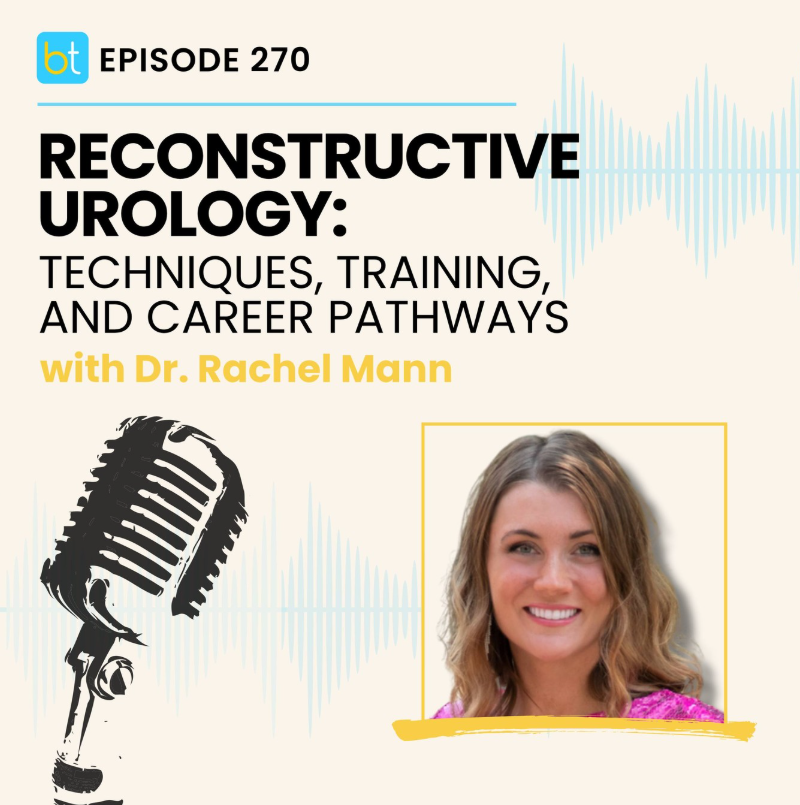
Dr. Rachel Mann joins Dr. George Koch on the BackTable Urology podcast to share her journey in reconstructive urology, lessons from her mentors, and what it takes to succeed in this creative and evolving subspecialty.
Endourology Fellowship
Our fellowship program emphasizes minimally invasive urologic surgery with an emphasis on kidney stone disease as well as management of benign prostatic hypertrophy. The fellow will participate in providing comprehensive kidney stone management, including gaining fundamental understanding and being able to provide treatment for metabolic stone disease, outpatient clinical stone care, and endoscopic surgical treatment of all stone types. Endourologic techniques including complex retrograde ureteroscopic renal surgery as well as percutaneous renal surgery including directed percutaneous access will be emphasized. A variety of BPH surgical treatments are offered with emphasis on Holmium Laser Enucleation of the Prostate (HoLEP).
This fellowship program is led by Dr. Michael Borofsky. Affiliated faculty that will participate in fellowship education include fellowship-trained endourologists Drs. Deepak Agarwal and Vishnu Ganesan.
The 2026 Endourology Fellowship Match
| Registration Open |
Registration Deadline |
Rank List Begins |
Rank List Deadline |
Match Results Released |
|---|---|---|---|---|
| Dec 11, 2024 | May 16, 2025 | June 10, 2025 | June 24, 2025 4:30 p.m. EST |
July 21, 2025 |
Duration
The clinical portion of the experience is 12 months in duration. The fellowship typically starts August 1st.
Clinical Experience
The majority of clinical time will be spent between Drs. Borofsky, Agarwal, and Ganesan. Overall case volume will exceed the ability to be present for all endourological procedures, as there are often cases being performed by separate surgeons at the same time, usually at different hospital locations. Fellowship exposure would be expected to be around 100-150 PCNLs with access, 100-150+ HoLEPs, and 100-150+ ureteroscopies, though it may vary based on preference, as we typically allow the fellow to choose which cases they would most likely want to cover during a given day. Clinic is generally 1/2 day per week hybrid/virtual/in-person and with oversight/support from a faculty member. The main goal of outpatient clinic is to gain comfort in counseling for surgical treatment, metabolic stone disease, and post-operative care.
Curriculum and Research
The schedule can vary from week to week depending on what cases are on the OR schedule. A typical week consists of three days in the operating room, one day in clinic, and 1/2 to 1 full day of administrative/research time. Research opportunities are available both within the department with clinical faculty, as well as in collaboration across the wider Medical School and University campus, including the Veterinary School.
Training Sites
Endourology procedures are performed at several hospitals within the system. In most cases, the fellow would only be at one site on a given day.
How to Apply
Application details can be found on the Endourology Society Website.
Urologic Oncology Fellowship
The Urologic Oncology Fellowship aims to create future leaders in the field of urologic oncology. The fellowship is composed of two years, one primarily consisting of research and one consisting of clinical training.
Research Training
The fellow will spend a year doing urologic oncology research. There are opportunities for outcomes research, decision modeling, translational research, artificial intelligence, basic science, and medical device development.
Clinical Training
The fellow will learn a multidisciplinary approach to all major urologic cancers including adrenal, renal, ureteral, bladder, prostate, penile and testicular. The fellow will also be trained to collaborate with gyn-oncologists and colorectal surgeons for combined large pelvic tumor surgeries.
Contact
Oncology Fellowship Director
Chris Warlick, MD, PhD
Residency and Fellowship Administrator
Emily Mucklow
[email protected]
Surgical Approaches
The fellow will learn an individualized approach to selection of surgical approach with historical numbers demonstrating the surgical approach as follows: open (35%), endoscopic (11%) and laparoscopic/robotic (54%) surgery. The anticipated case volumes are as follows based on past fellow case logs:
| Operation | Number per year | Robotic/Lap |
|---|---|---|
|
Radical Prostatectomy |
57 |
95% |
|
Radical Cystectomy |
65 |
35% |
|
Radical Nephrectomy |
19 |
40% |
|
Partial Nephrectomy |
42 |
90% |
|
RPLND |
8 |
50% |
|
Pelvic Lymphadenectomy |
123 |
65% |
|
Neobladder |
9 |
0% |
|
Ileal Conduit |
27 |
4% |
|
Inguinal Node Dissection |
8 |
7% |
|
TURBT |
18 |
n/a |
|
Ureteroscopic Biopsy/Tumor ablation |
10 |
n/a |
Former Urologic Oncology Research Fellow
Daniela F. Ward Grados, MD

I was born and raised in Mexico City, surrounded by friends and family, and that upbringing instilled in me a deep appreciation for community and connection. This foundation ultimately guided my decision to attend the University of Minnesota. My journey to the University of Minnesota began with a recommendation from my friend’s father, who had trained as a colorectal surgeon at the university. He spoke highly of the kind people and the vast academic resources provided to residents and researchers. After that, one look at the urology program convinced me that this was where I wanted to work. There is representation of every area of urology and every practice setting, which makes the University of Minnesota an ideal place to be a researcher. While at the university, I’ve been able to work on my leadership skills by forming a prostate cancer research group with medical students and other research fellows. Working here also helped me further develop my clinical skills as I observed a wide variety of surgical procedures/cases and tested my knowledge by participating in all the program’s academic activities. I published my first-ever research paper as a first author, a review of the advances in immunological therapies for bladder cancer. I got to travel nationally and internationally to present the results of my research projects, meet important figures in the world of urology, and finally match into the specialty of my dreams - all thanks to the help, guidance, and support of the UMN faculty and residents. If you’re considering applying to the University of Minnesota, do it! I couldn’t be happier with the time I spent working here. Make sure to take the time to meet everyone and foster those relationships. The mentorship offered by the faculty is invaluable and I leave the university knowing that I made friends and mentors for life.