Program Details
Program Details
- Schedule & Rotations
- Conferences
- Orientation Topics
- IMED
- Ultrasound
- Scholarly Activity
- Stipends & Benefits
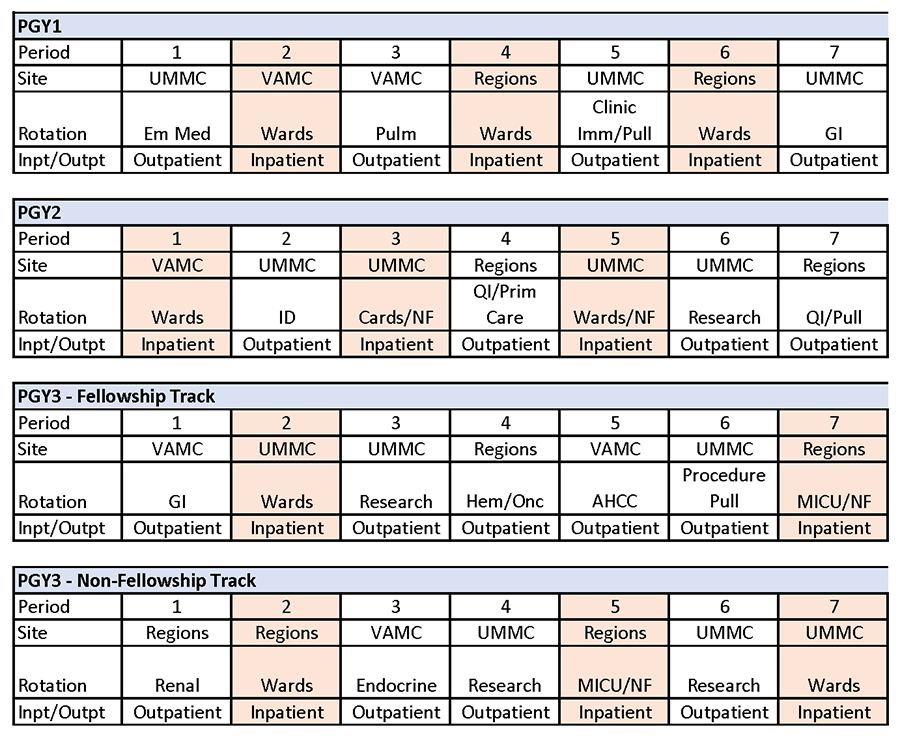
Example Schedule By Year
Rotation Structure
We follow a 50/50 structure, which is a modified version of the 4+4 schedule. All of our rotations have night float; our residents do not have 24 hour shifts.
Rotation requirements by Year of Training (1 period=4 weeks)
PGY-1
- 6-8 periods of inpatient rotations
- Of this, 4-6 weeks of Swing and/or Night Float
- 5-7 periods of non-inpatient rotations, this includes:
- 1 period emergency medicine rotation
- 1 period continuity clinic immersion rotation
- Continuity clinic 1 day per week on non-inpatient months
PGY-2
- 5-7 periods of inpatient rotations
- Of this, 4-8 weeks of Night Float
- 5-7 periods of non-inpatient rotations, this includes:
- 4 weeks Quality Improvement
- 2 Weeks of Geriatrics, Neurology, Palliative Care & Addiction Medicine (PGY-2 or PGY-3 year)
- 1-2 rotations of additional electives including research, international course
- Continuity clinic 1 day per week on non-inpatient months
PGY-3
- 4-6 periods of inpatient rotations
- 7-9 periods of non-inpatient rotations
- 1-2 rotations of additional electives including research, an international rotation or global health live course
- Continuity clinic 1 day per week on non-inpatient months
Electives
UMMC: Addiction Medicine, Cardiology Elective, Consult and Procedure Service, Dermatology, Endocrinology, Emergency Medicine, Global Medicine, Heme Onc and BMT, Hospitalist, Infectious Disease, International Rotations, GI Consults and Outpatient Clinic, Nephrology Consults and Outpatient Clinic, Palliative Care, Pulmonology Consults and Outpatient Clinic, QI Didactics/Experiential, Research Rotations, Rheumatology, Ultrasound, Women’s Health
Regions: Cardiology Consults and Outpatient Clinic, Critical Care Elective, Emergency Medicine, Gastroenterology, Geriatrics, Global Health, Heme Onc Consults and Outpatient Clinic, Hospitalist, Infectious Disease, Multispecialty Outpatient Clinic, Nephrology, Palliative Care, Pulmonology, QI Didactics/Experimental, Rheumatology, Sports Medicine, Toxicology, Travel Medicine
VAMC: Cardiology Elective, Dermatology, Emergency Medicine, Endocrinology Consults and Outpatient Clinic, GI Consults and Outpatient Clinic, Geriatrics, Heme Onc, Infectious Disease, Multispecialty Outpatient Clinic, Palliative Care, Pulmonology Consults and Outpatient Clinic, Nephrology, Rheumatology, Sleep Medicine, QI Didactics/Experiential, Women’s Health
Resident conferences are high quality and well attended. Some of the highlights include:
Morning report
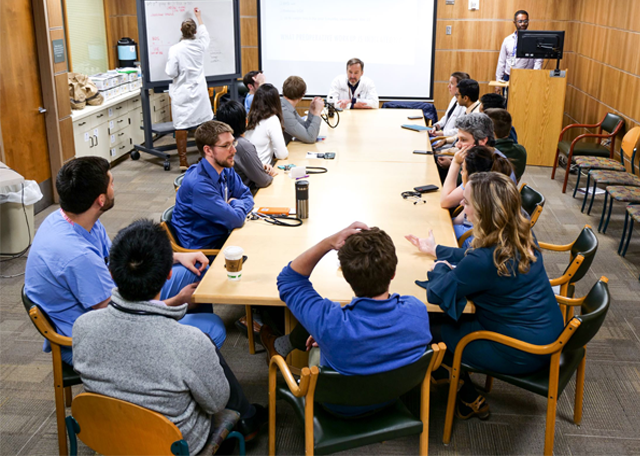
Chief residents lead case-based discussion on a variety of core medical topics and interesting cases to enhance learning. This conference is attended by medical students, residents, and faculty to create an optimal learning environment for developing clinical management skills and medical knowledge. Cases are archived online for residents to review at their convenience.
Morbidity and Mortality
Chief residents direct a process-oriented approach to a clinical case with emphasis on pitfalls in diagnostic reasoning and important topics in quality improvement or systems-based issues. Expertise is provided by teaching faculty, including an array of sub-specialists. Each site conducts its own M&M series so residents are able to attend this conference regularly, regardless of the current site they are rotating at.
Grand Rounds
Specialty experts discuss cutting-edge research topics and clinical advancements in didactic sessions. Each clinical site has its own Grand Rounds series which residents are able to attend.
Continuity Clinic Conference
Preceptors and residents lead interactive, case-based teaching sessions on ambulatory topics during each continuity clinic. Cases are shared electronically with residents for future reference.
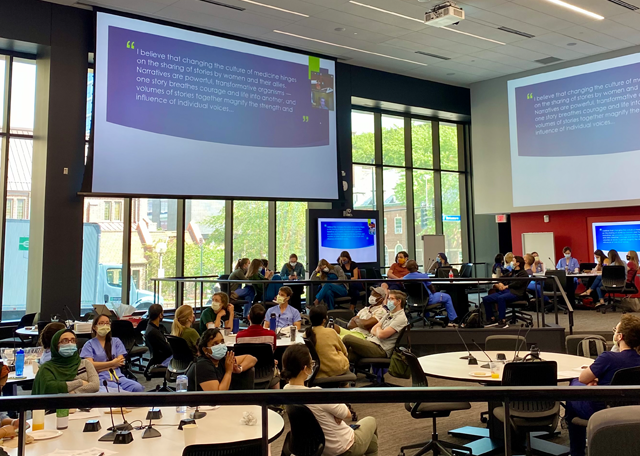
Other miscellaneous conferences: Residents have the ability to participate in a variety of other conferences including Schwartz rounds, combined EM/IM case conference and research conferences.
Communication Assessment and Skills Exercise (CASE)
This OSCE-format workshop was developed for new interns to practice delivering bad news, discussing code status, and dealing with angry patients in a safe, supportive environment.
Introduction to Ultrasound
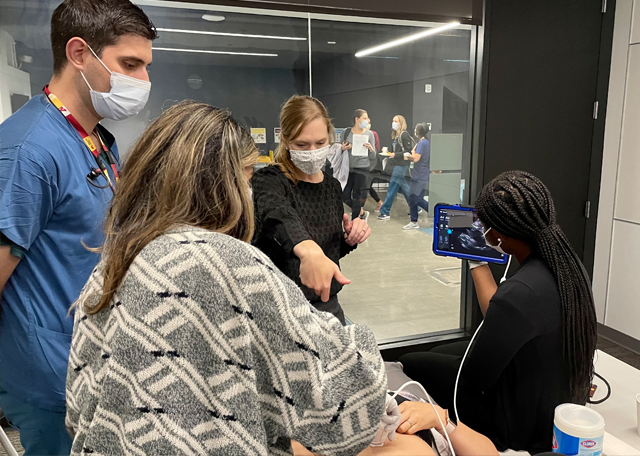
This introductory course includes directly-observed simulation in central line placement, radial artery line placement, thoracentesis/ chest tube placement, and paracentesis. It also includes hands-on instruction in the FAST exam, pulmonary and pleural evaluation (including lung sliding, pleural effusions, A-lines, and B-lines), and basic ultrasound assessment of the heart and great vessels (including contractility, pericardial effusion, and inferior vena cava size and variability) among other clinically useful assessments.
BLS/ACLS
Interns spend two days receiving training and certification in both basic and advanced life support.
IMED is a monthly academic half-day designed to cover essential topics and skills paramount to a career as an internist. IMED sessions utilize a variety of didactic techniques including small group discussions, procedural practice, and problem based learning. Intern and senior residents have separate sessions to help tailor learning across training levels. The curriculum is designed to be a longitudinal series without repeated content, and time is fully protected to ensure residents can fully immerse themselves in learning without the distraction of clinical responsibilities. Completion of the IMED curriculum will arm residents with a solid knowledge base for a variety of internal medicine conditions and provide explicit training in areas such as professionalism, implicit bias, high value care, and more to ensure residents emerge from training well-rounded providers.
Intern Curriculum
Intern sessions focus on improving the basic fund of knowledge and management of critical and common inpatient and outpatient conditions.
Sessions Include:
- Intern 101
- Liberty & Justice/Professionalism/DEI
- Critical Care
- Primary Care
- Palliative Care
- Renal
- Abdomen Day
- Dyspnea 1
- Common Infections
- Benign Hematology
- Research & Scholarships
- Emergencies
- Transition Workshop
Senior Curriculum
Senior sessions work to expand knowledge of less common pathology, build on and refine management of complex patients, and develop skills related to leadership and interprofessional team building. The senior curriculum is a two year curriculum so every senior resident will see each session once during their second and third years.
Sessions Include:
- Dyspnea 2
- General Internal Medicine: inpatient
- Women's Health 1
- General Internal Medicine: outpatient
- Board Review
- Career Development Retreat
- Cardiology
- Dermatology
- Palliative and Geriatric Care
- Pain Management
- Endocrine Nodule Day
- Board Review 2
- Rheumatology
The University of Minnesota offers a curriculum in medical procedures and in diagnostic point-of-care ultrasonography in which all Internal Medicine, Medicine-Pediatrics, and Medicine-Dermatology residents participate beginning their intern year.
Introductory Course
Includes directly-observed simulation in central line placement, radial artery line placement, thoracentesis/ chest tube placement, and paracentesis. It also includes hands-on instruction in the FAST exam, pulmonary and pleural evaluation (including lung sliding, pleural effusions, A-lines, and B-lines), and basic ultrasound assessment of the heart and great vessels (including contractility, pericardial effusion, and inferior vena cava size and variability) among other clinically useful assessments. All incoming interns take this course as part of intern orientation.
Advanced Ultrasound Course
Offered as an elective to senior residents two times per year. The course focuses on diagnostic point-of-care ultrasound, and reinforces many of the concepts from the introductory course; as well as integrating these ideas into the workup of hypotension, dyspnea, and assessment of intravascular volume. Interested resident can also learn evaluation for lower extremity deep venous thrombosis and abdominal aortic aneurysms. A significant portion of the course is spent scanning a large number of patients admitted to UMMC and building portfolios demonstrating ability to acquire and interpret images.
Hospital Medicine Bedside Procedure Service (HMBPS)
Offers paracentesis, thoracentesis, and lumbar punctures. This is a two week rotation available to senior residents as an elective. Residents continue to learn procedures on other rotations as well, and perform procedures and Regions Hospital and the VAMC. If a resident wishes to take both the Advanced Ultrasound Course and HMBPS rotation, the resident would ideally take the advanced course first, as extra time on the HMBPS service may then be used for additional portfolio building.
Internal Medicine Residency Program Scholarly Activity
Our program supports scholarly activity by providing all interns with 5 days/year for professional development, $200 for academic expenses, and MKSAP and ACP membership. Senior residents have $600/year year for academic expenses. PGY2 residents also have 5 days/year for professional development, and PGY3 residents have 10 days/year. All of our residents can also take an additional day each year for advocacy or volunteer work.
Possible Scholarly Activities
- Participate in clinical, educational, or basic science research
- Present an interesting clinical case at fall Minnesota ACP (usually held in downtown Minneapolis)
- Present a poster at Department of Medicine Research Day in the spring
- Present an abstract at a national or international subspecialty conference, such as CHEST, DDW, ASCO, or ACC meeting.
- Attend workshops or present at Midwest SGIM (Society for General Internal Medicine) or CGEA (Central Group on Educational Affairs), held in a Midwest city each spring
- Publish a case report, abstract, or original research
Financial Benefits
Educational Allowance
- $200.00 in the first year
- $600.00 in the second and third years
- May be used for medical-related expenses including: Books, journal subscriptions, medical software, travel to scientific/medical meetings or conferences
On the Job Benefits
Off The Job Benefits
Insurance & Tax Benefits
Educational Benefits
For more detailed information please refer to the GME Stipend and Benefits page