
The winding paths to Medical School
At the University of Minnesota Medical School’s summer white coat ceremony, the milestone of receiving a white coat marks the beginning of medical school, but the true foundation of each future physician is built long before they ever step on campus.
While the destination is the same, no two journeys to medical school look the same.
Whether shaped by the tactical field hospitals of the National Guard or the non-traditional path of an undergraduate liberal arts degree, future physicians enter the profession shaped by the unique challenges that defined their roads to medical school.
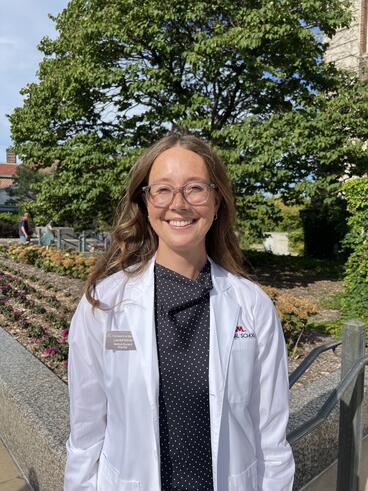
From the National Guard to medicine
For Minnesota Army National Guard medic Lauren Kitner, the journey to medical school began in New Prague, Minnesota, a small, southern Minnesota town about 50 miles outside of the Twin Cities.
Growing up, healthcare felt personal at an early age, and her interactions with her primary care provider left a lasting impression.
"My provider knew my name, my family, and our stories," Kitner says. "At visits, they took the time to listen about what was happening in my life rather than immediately jumping into discussions regarding my health. The basis of trust during these encounters allowed me to feel comfortable with the medical community. I want to create a similar welcoming, safe atmosphere for my future patients."
That focus on community and personal connection drew her to the military. Serving as a medic in the National Guard — where she maintains active service and plans to commission as a medical student officer — provided invaluable hands-on clinical experience.
Working alongside doctors and physician assistants during annual training in field hospitals challenged her in unique ways, she says.
"Having the opportunity to test my medical knowledge in resource-limited environments challenged me to think critically and come up with a diagnosis before presenting the case to our providers," Kitner says. "Working closely with the providers and receiving feedback allowed me to refine my craft."
Wanting an educational environment that understood her unique military background, she found her place in the Military Medic to Medical School program at the University of Minnesota.
Through Military Medic to Medical School and her undergraduate studies in Health and Wellbeing Sciences at the University’s College of Continuing and Professional Studies, she gained crucial support for her medical journey.
While she remains undecided on a specific medical specialty, she says she is interested in exploring fields such as emergency medicine, pediatrics and general surgery during her clinical clerkships.
In medical school, and throughout her military and civilian career, Kitner remains driven by a simple promise.
"I will be a provider who listens first and foremost to my patients and has their stories and concerns on the forefront of my mind,” she says.
Bridging culture and global health
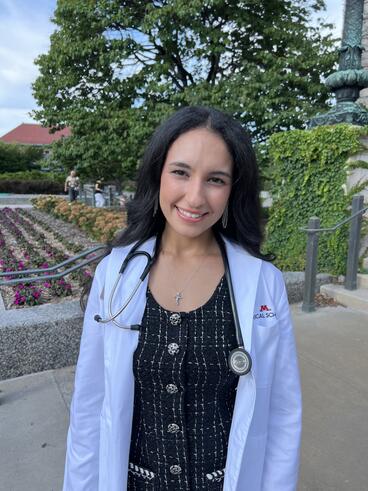
For Stillwater, Minnesota, native Shania Youssef, the path to medical school has always been rooted in a deep sense of community, cultural awareness and a desire to serve others.
Growing up in a household shaped by Egyptian heritage, where many family members did not speak English as a first language, healthcare was viewed through a unique lens.
While Youssef knew early on that she wanted to pursue medicine, her background didn't fit the traditional mold.
"I wasn't sure what it was going to be like," she reflects. "I didn't have the most traditional socioeconomic background or family in medicine."
Everything changed when she stumbled upon a specialized opportunity while applying to college — an experience she calls a "big blessing." As a high school senior, she applied to the University’s Bachelor of Arts/Medical Doctor (BA/MD) Scholars Program, a highly competitive partnership between the College of Liberal Arts and the Medical School designed for exceptional students committed to meeting the healthcare needs of all Minnesotans.
The rigorous program opened the door to a community that provides students with important mentorship and resources. Crucially, it offered a space where individuals from diverse and medically underserved backgrounds could find a pathway to medical school.
"The value of cultural awareness — making a physician population represent the general population — really resonates with me," Youssef says. "Being in the program has given me confidence in myself and a space where people like me could be part of something, contribute meaningfully and find the right resources and mentorship."
At the University, she majored in Biology, Society, and Environment, offered through the College of Liberal Arts, which struck a balance between the hard science of biology and the humanities, Youssef says. The major encouraged her to look at science through a broader, critical perspective, such as examining how science impacts people, where health disparities exist and how modern technology can either help or harm different populations.
"It gave me a lot of insight and asked difficult, uncomfortable questions about premedical classes," she explains. "It pushed me to think about science not just empirically, but globally — looking at international health and how disparities are being addressed."
As she steps forward in her medical education, Youssef remains open-minded about her future specialty. Every time she shadows physicians, she finds herself drawn to the procedural side of medicine, particularly fields utilized in global health and justice work.
Deeply motivated by her faith, her family and her life experiences, Youssef views reaching the white coat ceremony as the culmination of countless late-night study sessions, the mentorship she actively sought and the support of a village that carried her to this point.
"I'm super excited,” she says. “It's a dream come true. I can't believe I've made it to this point. Time really flies."