Experimental Design & Technological Assistance
Experimental Development and Design
The Addiction Neural Dynamics Core offers several services to aid investigators with development and design of their experiments to answer their research questions.
- Experimental development and design. The ANDC will provide consultation to clients to help formulate a strategy for the best imaging and behavioral technique to utilize. This will include meeting with the ANDC manager to discuss experimental needs and timelines.
- IACUC protocol amendments. The ANDC will provide assistance with developing IACUC protocol amendments based on the surgical and behavioral procedures used in the ANDC and of the specific experimental need.
Technological Assistance: Development and Implementation
The Addiction Neural Dynamics Core offers investigators extensive assistance in coming up with technological solutions for investigators attempting to image cellular activity during behavior.
- Surgical implantation of imaging devices. The ANDC can provide direct help and training with surgical implantation of the custom brain windows based on specific experimental needs of the client. Proper use of anesthesia, animal monitoring (perioperative and postoperative), and aseptic surgical techniques will all be covered.
-
Design and fabrication of transparent polymer skulls.
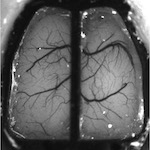
The ANDC can customize transparent polymer skulls (See-Shells) for new applications and various brain regions of interest. We can also provide full assembly of the transparent polymer skulls so they are ready for surgical implantation.
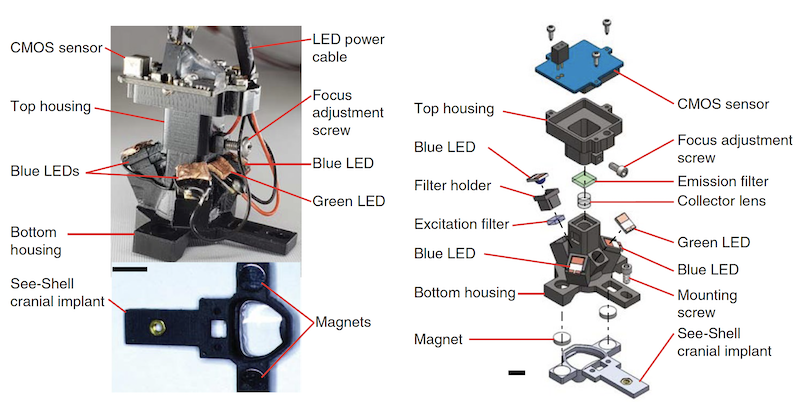
- Development and assembly of miniaturized imaging devices. We can fabricate and set up miniscopes and mini-mscopes which are used to investigate neural circuits in freely behaving mice. Additionally, we provide engineering consultation to modify current device designs to target other brain regions of interest. We are currently implementing a miniscope to image in the nucleus accumbens. We are using mini-mscopes to image cortex-wide neural activity in mice during a variety of sensory evoked stimuli and during social behavior.